
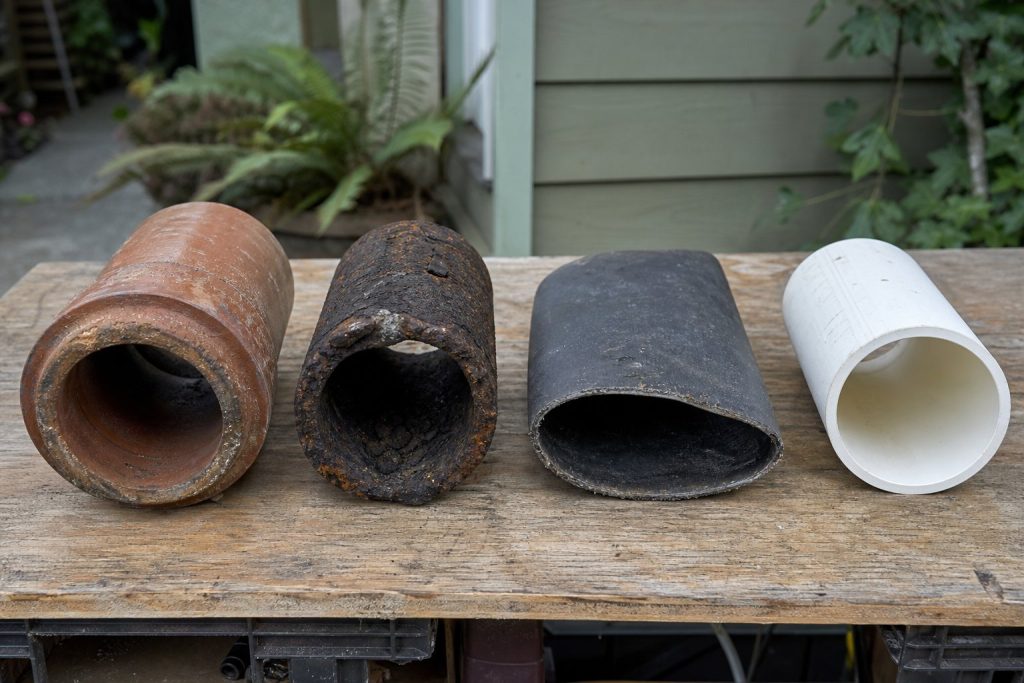
If your home was built a few decades ago, the sewer line under the yard may be made of a material that is no longer installed today. Clay, cast iron, concrete and orangeburg pipe all carried wastewater for generations, but each one ages differently. Knowing which one you have explains why clogs keep returning, why roots keep coming back, and whether cleaning, a section repair or replacement is the realistic next step.
- Older sewer lines are usually clay, cast iron, concrete or orangeburg; newer lines are usually PVC or ABS plastic.
- Each material has typical weak points: joints and roots in clay, internal corrosion in cast iron, deformation in orangeburg.
- The material can change along the same line, especially where earlier repairs were made.
- A sewer camera inspection is the most reliable way to confirm the material and its condition.
Why the Material of Your Sewer Line Matters
Pipe material decides how a sewer line fails and which repairs make sense. A clay line with one root-filled joint may only need a section repair. A cast iron line that has corroded through along the bottom may not hold up to another cleaning. An orangeburg line that has started to flatten often needs replacement. The material also affects how aggressively a line can be cleaned, which matters if you are considering hydro jetting.
Clay Sewer Pipe
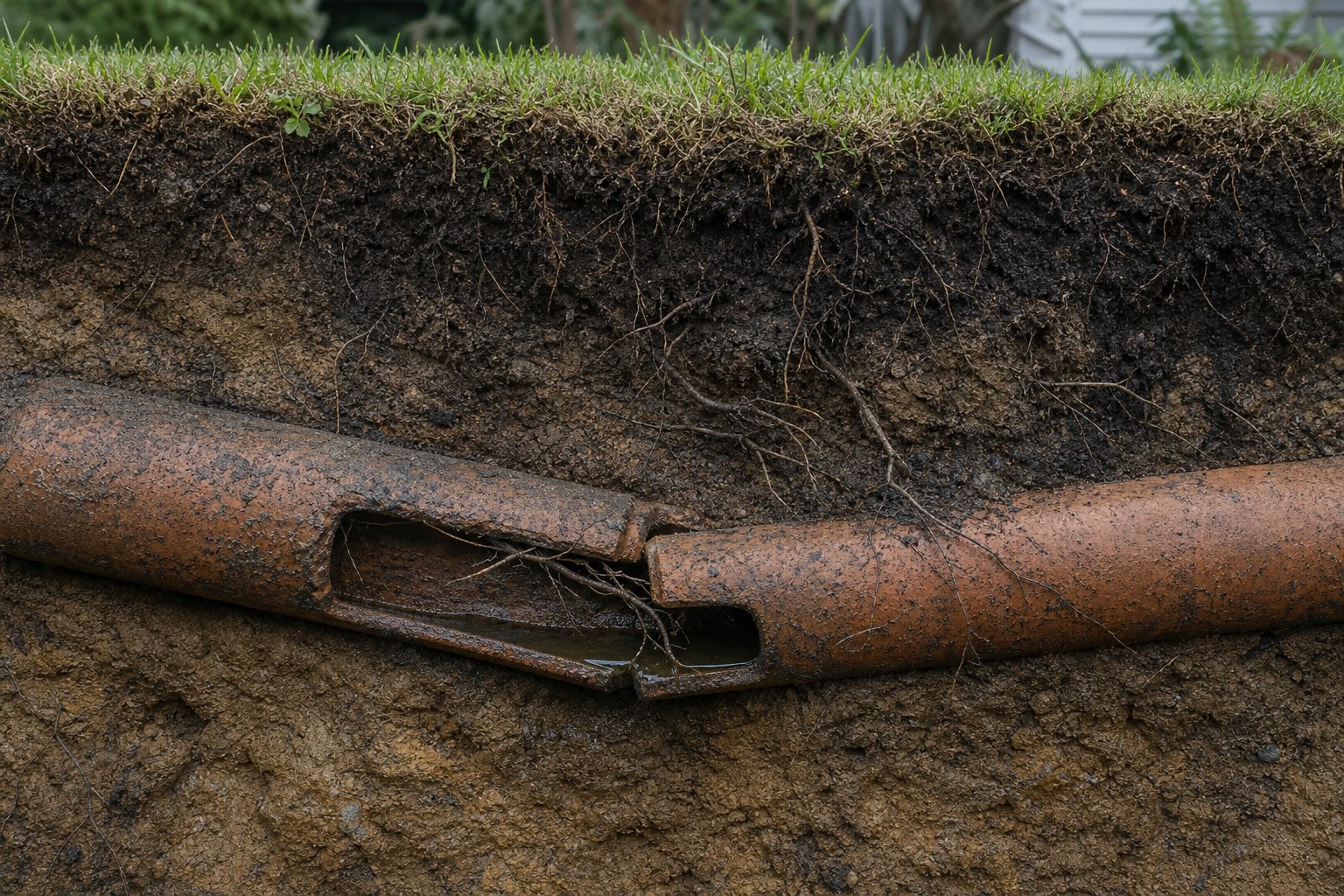
Vitrified clay pipe is fired clay that resists corrosion and most household chemicals, so the pipe wall itself can last a long time. The weak points are the joints. Clay pipe comes in short sections, and each joint is a place where roots can enter, soil movement can create an offset, or a crack can start under heavy loads such as vehicles or settling soil.
Typical signs of trouble in a clay line include recurring clogs at about the same distance from the cleanout, roots returning after cleaning, and slow drains that improve after snaking but never stay fixed. See tree roots in a sewer line for how root intrusion develops.
Cast Iron Sewer Pipe
Cast iron is strong and quiet, and it was used for decades both under homes and in the main stack. It wears from the inside: scale and corrosion build up over time, roughen the interior and narrow the opening, which catches paper and grease. As corrosion advances, the bottom of the pipe can thin and crack, and the pipe wall can eventually lose its shape.
Signs include slow drains throughout the house, rust-colored flakes in a backup, and repeat clogs even without roots. A cast iron line that is still sound inside can often be cleaned and kept in service. One that has thinned or cracked needs a closer look before any aggressive cleaning.
Orangeburg Pipe
Orangeburg is a fiber pipe made from wood pulp and pitch that was widely used for sewer laterals in the middle of the 20th century. It was light and inexpensive, but it absorbs water over time, softens, blisters and can deform into an oval or collapse under soil weight. Roots also push through it more easily than through clay or cast iron.
If an inspection finds orangeburg, plan for repair or replacement rather than repeated cleaning. Many plumbers avoid jetting orangeburg because high pressure can tear a softened wall.
Concrete Sewer Pipe
Some older properties have concrete sewer pipe. Like clay, it comes in sections, so joints can separate or let roots in. Over many years the inside surface can also erode, leaving a rough interior that holds debris. Its condition varies widely, which is why an inspection matters more than the pipe’s age.
PVC and ABS Plastic Pipe
Most sewer lines installed or replaced in recent decades are PVC or ABS plastic. The pipe is smooth, resists corrosion and roots, and comes in longer lengths with fewer joints. Problems in plastic lines usually come from installation or ground movement: a low spot (belly) that holds water and waste, a joint that has shifted, or damage from digging.
How to Tell What Your Sewer Line Is Made Of
- The age of the home and any sewer work since: original lines in older homes are more likely to be clay, cast iron, concrete or orangeburg, but many have been partly replaced.
- Visible pipe: where the line leaves the house, at a basement wall or an indoor sewer cleanout, you may see cast iron or plastic. That only tells you about the first few feet.
- Past reports: a pre-purchase inspection or an old repair invoice may already name the material.
- A camera inspection: the only reliable way to see the whole run, including where one material changes to another and the condition of each joint.
A sewer camera inspection records the inside of the line and shows roots, cracks, offsets, sags and buildup, so you can make a decision based on what is actually in the ground. For more on what a scope shows, see sewer scope inspection.
Signs an Older Sewer Line Is Failing
- Clogs that return within weeks or months after cleaning.
- Several drains slowing down at once, or water backing up into a low tub or floor drain.
- Sewer odors in the basement or yard.
- Soggy or unusually green patches along the path of the sewer line.
- Roots or pipe fragments brought back by a cleaning cable.
These signs overlap with an ordinary clog, so it helps to compare them with main sewer line clog signs before deciding.
Repair, Lining or Replacement?
The right fix depends on how much of the line is affected. One cracked or root-filled section in an otherwise sound line can often be repaired on its own. When defects run along much of the line, or the material itself is failing, as with deformed orangeburg or badly corroded cast iron, replacing the line is usually the longer-term answer. Trenchless methods such as lining exist for some lines, but suitability depends on the pipe’s shape, condition and access, and not every contractor offers them.
Compare the options in sewer line repair vs. replacement and trenchless sewer repair explained, and see what affects sewer line replacement cost.
Can Older Pipes Be Hydro Jetted?
Sometimes. Sound clay and cast iron lines often handle jetting with the right pressure and nozzle, while orangeburg and badly damaged lines usually do not. The decision should follow an inspection. See can hydro jetting damage pipes for how pipe material changes the risk.
Conclusion
Clay, cast iron, concrete and orangeburg sewer lines each fail in their own way, and the material often explains why a problem keeps returning. If you live in Everett, Stanwood, Camano Island, Granite Falls, Mount Vernon or nearby and suspect an older line, start with a sewer camera inspection, then decide between cleaning, a section repair or replacement with our sewer cleaning, repair and replacement service.