
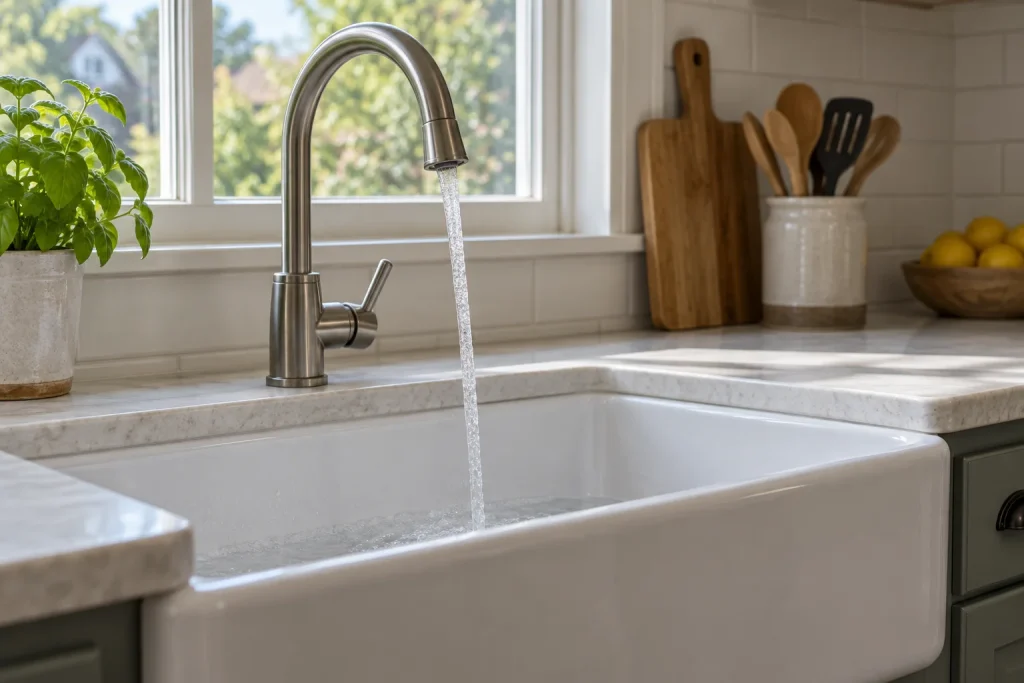
If you’re asking what causes low water pressure, you’re probably dealing with a shower that barely rinses shampoo or a sink that takes forever to fill. The tricky part is that “low pressure” can be two different problems: true water pressure (the push in the pipes) or low flow (how much water actually comes out). And each has totally different fixes.
In this guide, you’ll learn how to tell the difference, what “normal” looks like, how to test your home with a simple gauge, and how to troubleshoot fast. Then we’ll walk through the most common causes inside your house, pipe-related issues in older homes, and outside utility problems.
Best for: Homeowners who want to quickly figure out whether the issue is a single fixture, the whole house, or the city supply.
Not ideal when: You have active flooding, a sudden major drop with hissing sounds, or signs of water damage that point to a serious leak.
Good first step if: You can compare multiple fixtures and test pressure at an outdoor spigot with a simple screw-on gauge.
Call a pro if: The main valve is fully open but pressure is still low, or you suspect a failing regulator, leak, or service line problem.
Quick Summary
- Low pressure (push) and low flow (volume) feel similar, but they come from different causes.
- Normal water pressure is measured in PSI (pounds per square inch), and you can test it with a gauge.
- Single-fixture issues usually point to aerators, showerheads, or cartridges clogging.
- Whole-house issues often involve valves, a pressure-reducing valve (PRV), leaks, or aging pipes.
- Outside issues can be temporary, like utility maintenance, or bigger, like a water main break.
Low Water Pressure Vs. Low Flow: What’s the Difference?
Low pressure is weak push behind the water; low flow is a restriction limiting how much water gets through. Pressure is the force, flow is the volume delivered.
Pressure problems usually affect multiple fixtures and both hot and cold, pointing to a valve, PRV, leak, or supply issue. Flow problems are often localized, caused by a clogged aerator, showerhead, filter, or cartridge.
A quick clue is pattern. If only one fixture or one side is weak, suspect flow restriction before assuming a whole-house pressure failure.
Quick Symptoms Checklist
- Only one faucet/shower is weak: usually low flow from a clogged fixture.
- Every fixture is weak: more likely true low water pressure.
- Cold is fine but hot is weak: suspect the water heater side or a hot water line restriction.
- Pressure drops when you run two things at once: demand may be exceeding what the plumbing can deliver.
- Neighbors have the same issue: likely municipal water supply related.
What’s Normal Water Pressure in a Home (and How to Test It)
Home water pressure is measured in PSI, the force pushing water through your pipes. Low PSI makes showers and appliances weak, while very high PSI can stress plumbing components.
To test, screw a water pressure gauge onto an outdoor hose bibb and read the number with all water off. The hose bibb is a good baseline because it avoids many indoor restrictions.
If the reading seems low, test again at a different time of day to account for neighborhood demand changes.
How to Use a Hose-bibb Pressure Gauge
1. Pick an outdoor spigot close to where the water line enters the house, if you know it. 2. Screw the water pressure gauge onto the hose bibb snugly by hand. 3. Make sure no water is running inside the house. 4. Turn the spigot on fully and read the PSI number. 5. Repeat once when you normally notice the problem, like morning or evening.
Causes Inside Your Home (most Common)
Common indoor causes include clogged fixture parts, partially closed valves, a failing PRV, or leaks. First decide whether it’s one fixture or the whole house, because single-fixture problems are usually localized.
Check the easy clog points: aerators, showerheads, and cartridges. Sediment, mineral buildup, and rubber debris collect in tiny passages and can quickly cut flow.
If it’s whole-house, focus on the main shutoff valve, the water meter valve, and the PRV that regulates incoming pressure.
Outside problems can mimic indoor ones; see water line repairs.
Clogged Aerators/showerheads, Cartridges, or Whole-house Filters
Clogged aerators, showerheads, cartridges, and whole-house filters reduce flow by narrowing the water pathway. Start with the simplest checks.
Try:
- Unscrew and rinse the aerator; soak for mineral buildup.
- Remove and clean the showerhead and inlet screen.
- If only one faucet is affected, suspect the cartridge.
- Check and replace an overdue whole-house filter.
Partially Closed Shutoff/meter Valve, Failing PRV, or Leaks
A partially closed main shutoff or water meter valve can reduce pressure to the whole house, especially with older gate-style valves that fail internally. A PRV can also lower pressure if it’s mis-set, sticking, or worn and unstable. Leaks reduce usable pressure and volume; watch for wet spots, running-water sounds, or meter movement when all fixtures are off.
Pipe-related Causes (often in Older Homes)
In older homes, low pressure can come from pipe restrictions caused by mineral scale and corrosion that build over time. A common culprit is galvanized steel pipe, which corrodes internally and narrows the usable diameter, limiting flow.
Design can also cap performance. Undersized interior piping, or an undersized service line from the street, may not supply enough water when multiple fixtures run.
If the weak pressure seems tied to the street-to-house line, water service replacement explains why that segment matters.
Mineral Scale Buildup and Corrosion Restricting Pipe Diameter
Mineral buildup is hardened deposits left behind when water dries, and hard-water scale (limescale) is a common type. Inside a pipe, that scale creates a rough, narrower passage that increases friction and reduces flow.
Corrosion does something similar. Pipe corrosion forms flakes and roughness that catch debris and constrict water movement. In galvanized steel pipe, corrosion can get severe enough that some fixtures barely get water.
Typical signs include:
- Low pressure at many fixtures that slowly worsens
- Frequent aerator clogs with gritty particles
- Water that looks rusty for a moment after sitting, then clears once the line has flushed.
Undersized Piping or High-demand Situations (multiple Fixtures)
Undersized piping limits how much water can move through the home, even if incoming pressure is acceptable. High-demand use can mimic a “failure” when several fixtures compete for the same supply.
Clues include a shower weakening when a toilet flushes, the dishwasher fills, or irrigation runs. Common triggers include running laundry and a shower together, using hoses during indoor use, or multiple showers while other fixtures are on.
Causes Outside Your Home (utility/supply-side)
Outside causes often involve the municipal supply or the service line feeding your house. City pressure changes, main work, or upstream restrictions can reduce pressure, sometimes varying by time of day.
Compare with neighbors. If nearby homes have the same issue at the same time, it’s likely upstream of your plumbing.
A damaged, leaking, or partially blocked service line can also create whole-house low pressure without obvious indoor leaks. See water line repair options for typical next steps.
Main Breaks, Maintenance, Peak-demand Periods, Neighborhood-wide Low Pressure
Utility maintenance or a water main break can cause sudden low pressure while the system is repaired, flushed, or rerouted, sometimes with discolored water. Peak-demand periods can also drop pressure temporarily.
Signs it’s outside:
- Neighbors report the same issue
- Pressure is worse at certain times
- You saw crews working nearby.
Step-by-step Troubleshooting: Isolate the Source Fast
Isolate the source by comparing fixtures, hot vs. cold, and a pressure test at an outdoor spigot. Classify it as one fixture, hot-only or cold-only, whole-house, or outside supply.
Checklist: 1. Test 2–3 fixtures in different rooms. 2. Compare hot vs. cold at one faucet. 3. Check PSI at the hose bibb with a pressure gauge. 4. Ask a neighbor if they noticed the same change. 5. Verify the main shutoff is fully open. 6. Note PRV swings or inconsistency.
Street-to-house issues are covered in water service line repair.
One Fixture Vs. Whole House; Hot-only Vs. Hot and Cold
One weak fixture usually means a clogged aerator, showerhead, or cartridge, not a true pressure failure. Clean the aerator or showerhead first because it’s fast and low risk.
Whole-house weakness points you to valves, the PRV, leaks, or the supply side. Hot-only issues often live around the water heater or the hot water line. Cold-only issues can happen too, but they’re less common.
And don’t skip the “hot and cold” comparison. It’s one of the quickest ways to avoid misdiagnosing pressure as a fixture clog, or vice versa.
When to Call a Plumber (and What to Ask Them to Check)
Call a plumber after confirming the main valve is fully open, the issue is whole-house, and cleaning a faucet aerator or showerhead didn’t help. Call sooner for suspected hidden leaks, a failing PRV, or restrictions in older piping.
Ask them to check:
- Static pressure at the hose bibb and fixtures
- Main shutoff and water meter valve condition and position
- PRV output and stability
- Hidden leak signs, including a meter movement test
- Service line health if the drop seems street-to-house.
Hot-water-only symptoms may relate to water heater repair and replacement.
Conclusion
The answer to what causes low water pressure usually comes down to one of four buckets: a clogged fixture, a valve or PRV issue, aging pipes with restrictions, or a supply-side problem outside your home. Start by figuring out if it’s low pressure or low flow. Then test PSI at an outdoor spigot, compare hot vs. cold, and check whether neighbors are affected. Once you’ve narrowed the source, the fix is usually obvious. And if it isn’t, that’s your sign to bring in a plumber with the right tools.